
Stress is the leading cause of insomnia in France. When the nervous system remains in a state of alert at bedtime, falling asleep is delayed and sleep cycles are fragmented. Learning to relax before bed is not a luxury: it's a practical skill that can be acquired and strengthened with practice.
Why stress disrupts sleep
Under stress, the body releases cortisol and adrenaline, two hormones that keep the body in a state of alertness. These substances delay the drop in body temperature necessary for falling asleep and reduce the proportion of deep sleep in nighttime cycles. The anxious thoughts that accompany stress fuel this vicious cycle: the more you ruminate, the longer it takes to fall asleep, and the more anxiety increases.
To understand how stress specifically affects sleep cycles, our article on the links between stress and sleep disorders details the physiological mechanisms involved.
Relaxation techniques to fall asleep more easily
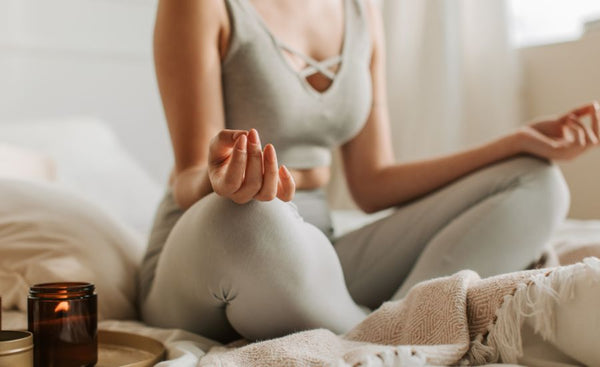
Breathing: the fastest lever
Breathing techniques act directly on the autonomic nervous system by activating the parasympathetic nervous system, the "rest and digestion" branch that counteracts the stress response. Heart coherence involves breathing at a regular rate of 6 breaths per minute (5 seconds inhale, 5 seconds exhale) for 5 minutes. Practiced before bed, it reduces cortisol levels and physiologically prepares the body for sleep. The 4-7-8 method (4 seconds inhale, 7 seconds hold, 8 seconds exhale) is also effective for quickly calming agitation. For more information, our article on breathing techniques for stress reduction details several protocols.
Meditation and body scan
A 10-minute meditation session before bed is enough to reduce prefrontal cortex activity and calm racing thoughts. The body scan, a relaxation technique that involves focusing attention on each part of the body in turn while releasing tension, is particularly effective for people whose insomnia is linked to muscle tension. Apps like Petit Bambou and Headspace offer guided sessions specifically designed for sleep.
Yoga and gentle stretching
Restorative yoga postures and gentle stretches practiced in the evening release muscle tension accumulated during the day and reduce cortisol levels. Lying postures (legs up the wall, savasana, child's pose) are particularly suitable as they activate the parasympathetic nervous system. A 15- to 20-minute session is enough to notice an effect on falling asleep.
Create an environment conducive to sleep

The bedroom environment influences the ability to relax. Several parameters need to be optimized.
The temperature should be between 16 and 18°C: above this, the body struggles to lower its core temperature, which delays falling asleep. Total darkness is recommended: blackout curtains eliminate external light sources. Evening bedroom lighting should be soft and warm, never cold or blue. Screens should be avoided in the hour before bedtime.
Bedding also plays a role: a mattress suited to your body type, pillows that properly support your neck, and sheets made of natural fibers (cotton, linen) that allow your skin to breathe all contribute to quality sleep. Our guide to bedding for a good night's sleep details the selection criteria.
Personalizing the space with calming elements (green plants, familiar objects, an essential oil diffuser) reinforces the mental association between the bedroom and rest. This association is one of the fundamental principles of sleep hygiene: the bedroom should be reserved for sleep and relaxation, not for work or screens.
Food and relaxation: the links
What you eat in the evening directly influences your ability to relax before sleep. A heavy meal keeps the digestive system active and raises body temperature, two factors that delay sleep onset. Foods rich in tryptophan (dairy products, bananas, eggs, poultry) promote the synthesis of serotonin and melatonin, the hormones of well-being and sleep. Caffeine and alcohol should be avoided after 4 p.m. To create the ideal dinner, our article on the ideal menu for a good night's sleep offers concrete examples.
Natural supplements to support relaxation
When relaxation techniques aren't enough, certain natural supplements can help you fall asleep. Melatonin helps resynchronize your biological clock and reduce the time it takes to fall asleep. Sedative plants like passionflower, valerian, poppy, and linden act on nervous tension and facilitate pre-sleep relaxation. These supplements should be part of a comprehensive sleep hygiene routine and not a substitute for changing your habits. If you are taking medication, consult a healthcare professional before using any supplements.
Frequently asked questions about relaxation and sleep
What is the most effective relaxation technique before going to sleep?
There is no one-size-fits-all technique: effectiveness varies depending on the individual and the nature of the problem. Breathing exercises (cardiac coherence, the 4-7-8 method) are the quickest to implement and produce results within minutes. Meditation and body scans are more effective for rumination and anxious thoughts. Restorative yoga is particularly well-suited to muscle tension. Ideally, two of these approaches should be combined in a fixed 20-minute routine before bedtime.
How to calm nighttime anxiety naturally?
Nighttime anxiety is often fueled by rumination. Writing down your worries on a piece of paper before bed (the "brain dump" technique) helps externalize them and free your mind. Slow, deep breathing quickly reduces cortisol levels. Passionflower and valerian are the best-documented herbs for reducing pre-sleep anxiety without creating dependency.
How long does it normally take to fall asleep?
The normal time it takes to fall asleep is between 10 and 20 minutes. Less than 5 minutes indicates significant sleep deprivation. Regularly exceeding 30 minutes suggests difficulty falling asleep. Regularly practicing relaxation techniques generally brings the time it takes to fall asleep back to normal within two to three weeks.