

Feeling hungry at the end of the day is not unusual. Several hours have passed since lunch, tiredness is setting in, and appetite naturally tends to increase as evening approaches.
However, an overwhelming urge to eat every night, even after a full dinner, may indicate that your meals are not filling enough, that you are restricting food too much during the day, that you are not getting enough sleep, or that you have developed a habit linked to the sofa and screens.
Before trying to eliminate every evening snack, it is therefore important to understand what your body is really asking for. Physical hunger is not managed in the same way as a craving for sugar caused by stress, boredom, or tiredness.
This situation may be part of a more general feeling that your appetite is difficult to control. Our article explaining why you may feel hungry all the time explores the main possible causes.
Is it normal to feel hungrier in the evening?
Yes. A moderate increase in appetite during the evening can be perfectly normal. Hunger is not determined only by the amount of time that has passed since your last meal. It is also influenced by your biological rhythm.
The body’s internal clock appears to favour a lower appetite in the morning and a stronger appetite towards the end of the day. This mechanism may help prepare the body for the period of fasting that occurs during sleep.
There is also a much simpler explanation: in the evening, we generally have more time to think about food. Work-related demands decrease, screens are switched on, and the food available in the kitchen becomes easier to access.
Genuine hunger before dinner or several hours after an early meal is therefore not necessarily a cause for concern. The problem arises mainly when eating becomes automatic, difficult to control, or significant enough to cause discomfort and guilt.
Why am I hungry at night? The 7 most common causes
1. You are not eating enough during the day
One of the most common causes of evening snacking is eating too little during the day. Skipping breakfast, having only a small salad for lunch, or cutting out starchy foods to lose weight can create an energy deficit that the body tries to compensate for several hours later.
The desire to “be good” or keep meals very light can then have the opposite effect. Hunger gradually increases, self-control becomes more difficult, and energy-dense foods become particularly appealing when you get home.
This is common among people who follow very strict dietary rules. The more a food is considered forbidden, the more likely it is to occupy your thoughts and be eaten in large quantities when the restriction becomes impossible to maintain.
The goal should therefore not be to eat as little as possible before the evening. It is more useful to distribute enough food throughout the day according to your activity level, individual needs, and hunger signals.
2. Your dinner is not filling enough
A dinner that looks large is not necessarily satisfying. A big plate of vegetables accompanied by very little protein, starchy food, or fat may temporarily fill the stomach without providing enough energy to last until bedtime.
Conversely, a meal made mainly from white bread, refined cereals, pastries, or a sugary dessert may be digested quickly and allow hunger to return soon afterwards.
A balanced dinner generally combines a source of protein, vegetables, a suitable portion of starchy foods or pulses, and a small amount of fat. This combination is often more satisfying than a meal presented as “light” but which is actually incomplete.
When hunger returns very quickly after dinner, our article explaining why you may still feel hungry after eating can help you assess both the composition of the meal and the way it was eaten.
3. You eat dinner too early
Someone who eats dinner at 6 p.m. and goes to bed around midnight remains awake for almost six hours after the meal. It is therefore not surprising for genuine hunger to return during the evening, especially after an active day.
The same problem can occur when dinner is delayed. If lunch was eaten at noon and the next meal does not take place until 9 p.m., hunger may become extremely intense before you even sit down at the table.
In this situation, a planned snack in the late afternoon may be more helpful than constantly fighting hunger. It allows you to arrive at dinner with a normal appetite rather than feeling as though you could eat everything available.
Meal times need to remain compatible with work, family life, and sleep. A routine adapted to your own schedule is generally more realistic than an allegedly ideal dinner time that is supposed to suit everyone.
4. You are not getting enough sleep
Lack of sleep affects appetite in several ways. First, it extends the amount of time during which you are able to eat. Someone who stays awake late into the night inevitably has more opportunities to snack.
Tiredness can also increase the appeal of foods that are high in sugar, salt, and fat. When mental energy is low, preparing a balanced snack requires more effort than opening a packet of biscuits.
Sleep deprivation may also disrupt several mechanisms involved in appetite regulation. It can increase the motivation to eat and encourage additional food intake, particularly in the form of snacks after dinner.
Establishing more regular sleeping hours can therefore have a genuine effect on evening hunger rather than being merely a general wellbeing recommendation.
5. Stress and emotions trigger the urge to eat
Eating can provide temporary comfort, distract you from a worry, or symbolically mark the end of a difficult day. However, this search for relief does not always correspond to a genuine need for energy.
The foods involved are rarely interchangeable. Physical hunger could usually be satisfied by a simple meal, while emotional eating often focuses on one particular food, such as chocolate, crisps, biscuits, cheese, or ice cream.
Habit can reinforce this mechanism. When watching a television series is always accompanied by a packet of biscuits, simply sitting down in front of the screen may eventually be enough to trigger the desire to eat.
This is not necessarily a lack of willpower. The brain has simply learned to associate a situation, an emotion, and a food reward. Changing this automatic response involves gradually creating a new ritual rather than imposing a sudden ban.
A short walk, a shower, a few minutes of breathing exercises, or a practical activity can help you move through an emotional craving. The techniques presented in our guide to calming your nerves naturally can also be incorporated into an evening routine.
6. You have been physically active
A workout, a physically demanding working day, or a long walk increases the body’s energy requirements. Hunger may appear immediately after exercise, but it can also be delayed for several hours.
Someone who trains at the end of the day but eats the same dinner as they would after a sedentary day may therefore experience significant hunger before bed.
In this situation, systematically ignoring the signal may not be appropriate. It may be necessary to make the meal slightly larger, plan a snack after exercise, or distribute food more evenly throughout the day.
Hunger linked to physical activity usually develops gradually and can be satisfied by several different foods. It therefore differs from a very specific and sudden craving, which is more likely to be associated with an emotion or a learned habit.
7. Certain medicines or health conditions increase appetite
Unusual hunger does not always result from what is on your plate. Some medicines can increase appetite, including corticosteroids, certain antidepressants, antipsychotic medicines, and some treatments used for epilepsy.
Intense thirst, frequent urination, persistent tiredness, and increased hunger may also prompt a doctor to investigate diabetes. Strong hunger accompanied by weight loss, palpitations, trembling, or intolerance to heat may point towards a thyroid disorder.
These symptoms are not enough to diagnose a condition yourself. They do, however, justify seeking medical advice, especially when the increased hunger has appeared suddenly or is accompanied by an unexplained change in weight.
Prescribed medication should never be stopped in an attempt to reduce appetite. A doctor can investigate another cause, adjust the treatment, or suggest an alternative when appropriate.
How can you recognise genuine hunger in the evening?
Physical hunger usually develops gradually. It may be experienced as an empty feeling in the stomach, a drop in energy, difficulty concentrating, or a general sense that several different foods would be suitable.
A craving is often more sudden. It tends to focus on one specific food and may appear immediately after a meal, while you are bored, in front of a screen, or after an unpleasant emotion.
These questions can help you tell the difference:
- How long has it been since I last ate, and was my previous meal complete?
- Would I also eat a simple food such as bread, yoghurt, or fruit?
- Did the feeling develop gradually or appear suddenly in front of a screen?
- Is my stomach asking for food, or am I mainly looking for distraction or comfort?
- Once I start eating, can I easily recognise when I have had enough?
This distinction should not become another rigid dietary rule. It is perfectly possible to eat for pleasure occasionally without being physically hungry. The aim is simply to stop feeling controlled by an evening habit that you do not understand.
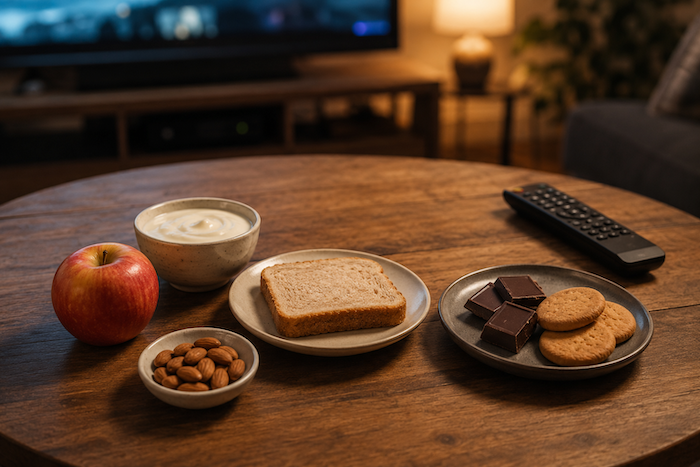
How can you avoid feeling hungry and snacking at night?
Eat enough at breakfast and lunch
You do not have to eat breakfast when you genuinely feel no hunger in the morning. However, repeatedly delaying the first meal of the day solely to reduce calorie intake may encourage compensatory eating later.
Lunch should also be sufficiently substantial. A source of protein, vegetables, starchy foods suited to your activity level, and some fat will generally keep you satisfied for longer than a meal made entirely from raw vegetables.
A late-afternoon snack can be useful when there is a long gap between lunch and dinner. Simple examples include fruit with yoghurt, a slice of wholegrain bread with a little cheese, or a small handful of nuts.
Prepare a genuinely filling dinner
A satisfying dinner should be neither excessively heavy nor artificially reduced. Nutritional balance is built across the whole day and week, but each meal still needs to provide enough nourishment.
A plate could, for example, combine cooked or raw vegetables with eggs, fish, chicken, tofu, or pulses, together with a portion of rice, pasta, bread, potatoes, or another grain.
Fat should not be removed completely. A small amount of oil, a few nuts, seeds, or avocado contributes to the enjoyment of the meal and can also slow digestion.
The NHS Eatwell Guide explains how different food groups can be combined to create a varied and balanced diet without relying on excessively restrictive rules.
Take time to eat without a screen
A meal eaten quickly in front of the television or a phone leaves less room for physical sensations. When attention is absorbed by a screen, it becomes harder to notice the taste of the food and the gradual arrival of fullness.
Eating at a table and slowing down does not guarantee that all hunger will disappear. It can, however, make it easier to distinguish the end of a meal from the urge to continue eating automatically.
Waiting a few minutes before serving yourself again may also help. Fullness does not always appear immediately after the final mouthful and may become clearer when the meal is given time to come to a proper end.
Change the ritual that triggers snacking
When snacking starts at the same time every evening, look at what happens immediately beforehand. The trigger may be starting a television programme, finishing dinner, walking through the kitchen, or experiencing a particular emotion.
The change should then focus on the context. Tidying the kitchen, brushing your teeth, preparing a herbal tea, moving to another room, or keeping your hands occupied can create a new transition between dinner and the rest of the evening.
You can also prepare a specific portion of the food in advance rather than keeping the whole packet beside you. This strategy does not make the food forbidden, but it reduces the risk of eating automatically without noticing the quantity consumed.
Gradually improve your sleep
Going to bed earlier may reduce opportunities to eat, but this advice is useful only when it corresponds to your individual needs. The main objective is to get a sufficient and relatively regular amount of sleep.
A consistent waking time, exposure to daylight in the morning, and reducing screen use towards the end of the evening can help strengthen the sleep-wake rhythm.
Caffeine consumed late in the day can encourage both insomnia and snacking. It delays sleep, prolongs the period spent awake, and may increase the restlessness that leads some people to eat.
What should you eat at night when you are genuinely hungry?
Real hunger does not need to be fought at all costs. A consciously chosen snack may be preferable to making several unplanned trips to the kitchen cupboards.
A useful snack can combine a source of protein or fat with a food containing fibre. Examples include plain yoghurt with fruit, wholegrain bread with cheese, a banana with a few almonds, or a small serving of yoghurt with oats.
Soup by itself or a piece of fruit may be enough when hunger is mild, but these choices may not be sufficient after an inadequate dinner or a physically demanding day.
The amount depends on your hunger, the time you ate dinner, your activity level, and how long remains before bed. There is no universal evening snack and no food capable of switching off appetite instantly.
For more ideas, our selection of naturally filling foods that help control hunger presents some of the most useful sources of protein, fibre, and water.
Does eating at night automatically cause weight gain?
No. Eating a snack in the evening does not automatically lead to weight gain. Changes in body weight depend on overall food intake, energy expenditure, sleep, physical activity, and many individual factors.
Timing may nevertheless have an indirect influence. Foods eaten late at night are often less planned, consumed in front of a screen, and high in energy. They may therefore be added on top of dinner without responding to genuine hunger.
The body’s biological rhythm may also make it less well adapted to consuming large amounts of food during the middle of the night. However, the available evidence does not justify banning all food after one particular time.
Someone who feels hungry after eating dinner very early is not in the same situation as someone who eats large quantities every night without hunger and with a feeling of losing control.
Rather than asking whether eating after a certain time is allowed, it is more useful to examine the reason, frequency, quantity, and way in which the food is being consumed.
When should nighttime hunger lead you to seek medical advice?
An occasional small appetite does not require a medical assessment. However, professional advice becomes useful when appetite changes suddenly, hunger becomes constant, or other symptoms appear alongside it.
You should consider seeking advice when:
- hunger is accompanied by unexplained weight loss or weight gain;
- you experience intense thirst, frequent urination, trembling, or palpitations;
- you regularly wake during the night specifically to eat;
- eating creates a feeling of losing control;
- large quantities are eaten rapidly, secretly, or until you feel physically uncomfortable;
- the behaviour causes shame, guilt, or significant emotional distress.
Night eating syndrome involves consuming a significant proportion of daily food after dinner or repeatedly waking up to eat, while remaining aware of the episodes and experiencing a real impact on everyday life.
It should not be confused with having a dessert, eating a planned snack, or occasionally feeling hungry after an early dinner.
The NHS overview of eating disorders explains that unhealthy eating behaviours can include eating too much or too little, using food to cope with difficult feelings, and experiencing a loss of control. A doctor, registered dietitian, or eating-disorder specialist can help distinguish these situations from ordinary evening hunger.
Frequently asked questions about evening hunger
Why do I crave sugar at night?
Sugar cravings can be encouraged by insufficient energy intake during the day, a lack of sleep, restrictive eating, stress, or a learned association between sweet food and evening relaxation.
A sugar craving does not automatically mean you are experiencing hypoglycaemia. When these cravings occur very frequently, it is useful to review the meals eaten during the day and the context in which the urge appears.
Is drinking water a good way to stop hunger?
Drinking is appropriate when you are thirsty, but water should not be used to repeatedly hide genuine hunger. Thirst and hunger are different sensations, even though they may sometimes be difficult to interpret when eating and drinking habits are irregular.
A glass of water can provide a useful pause. If the hunger remains and continues to develop gradually, eating a snack may be more appropriate.
Should you avoid carbohydrates at dinner?
No. Starchy carbohydrates can be included in an evening meal. The appropriate amount depends on your needs, physical activity, and the other foods included in the meal.
Removing them from the diet of someone who regularly feels hungry at night may even encourage snacking. Wholegrain cereals, potatoes, and pulses also provide fibre and help make a meal more satisfying.
Why do I feel hungry just before going to bed?
Dinner may have been eaten too early, may not have been substantial enough, or may not have matched the activity performed during the day. Tiredness and the bedtime routine can also trigger the desire to eat without genuine physical hunger.
When this feeling appears every night, it can be useful to try a more complete dinner or a planned snack and then observe whether the need persists.
Is it bad to eat fruit at night?
No. Fruit can be eaten in the evening when it is enjoyed and well tolerated. It does not automatically become more calorific or less healthy after a particular time.
When hunger is stronger, fruit can be combined with yoghurt, cottage cheese, or a few nuts to create a more satisfying snack.
How can I stop snacking in front of the television?
The first step is to break the automatic association between the screen and food. You can move food out of the room, prepare one specific portion, or replace the ritual with a warm drink, a practical activity, or a few gentle stretches.
When hunger is real, it is better to prepare a snack and eat it consciously than to make repeated trips to the kitchen throughout the entire evening.
Key takeaways
Feeling slightly hungrier in the evening can be normal. The body’s biological rhythm, the time that has passed since lunch, and the greater availability of food can all naturally increase appetite towards the end of the day.
However, repeated hunger that is difficult to control is often connected to insufficient food during the day, an incomplete dinner, a lack of sleep, stress, or a habit linked to screens.
The solution is not necessarily to ban every evening snack. The first step is to distinguish physical hunger from an emotional craving and then adapt lunch, dinner, sleep, and the way the evening is organised.
When eating becomes uncontrollable, causes significant distress, or occurs alongside other symptoms, seeking professional advice can help identify the cause without reducing the problem to a simple lack of willpower.