
In our modern society, nervousness affects more and more people. Between constant demands, the frenetic pace of daily life, and multiple sources of stress, our nervous system is put under considerable strain. Fortunately, there are many natural remedies to help restore inner calm and soothe nervous tension, all supported by science and validated by European health authorities.
What is nervousness?
Definition and mechanisms
Nervousness is a state of nervous system arousal that manifests itself both emotionally (irritability, anxiety, rumination) and physically (restlessness, muscle tension, palpitations). It is a natural response of the body to situations perceived as threatening or destabilizing, orchestrated by the hypothalamic-pituitary-adrenal axis and the release of stress hormones such as cortisol and adrenaline.
When this condition becomes chronic, it can have a significant impact on quality of life. According to the French National Health Insurance ( Assurance Maladie ), anxiety disorders affect approximately 15% of the French population and are one of the most frequent reasons for consulting a general practitioner.
Main causes
The triggering factors are numerous and often intertwined. Work-related stress, excessive workload, and relationship difficulties create fertile ground for chronic nervousness. Lack of sleep perpetuates a vicious cycle: nervousness disrupts sleep, and lack of sleep exacerbates nervousness. An unbalanced diet, low in magnesium, deprives the body of essential nutrients for nerve regulation. Overconsumption of stimulants (coffee, energy drinks) and a sedentary lifestyle complete this picture.
Symptoms to recognize
The manifestations of nervousness are both physical and psychological. Physically, muscle tension in the back, neck, and shoulders, palpitations, digestive problems, and sleep disturbances are frequently observed. Psychologically, symptoms include irritability, difficulty concentrating, rumination, and persistent mental fatigue. These signs should not be ignored because, if they persist, they can have a lasting impact on overall health.

The 6 most effective natural remedies to calm nerves
1. Saffron, the dual-action adaptogen
Saffron (Crocus sativus) is among the best-documented natural remedies for calming nerves. It benefits from health claims recognized by the EFSA (European Food Safety Authority) for its effect on mood and emotional balance, making it one of the few natural supplements with a solid regulatory basis in Europe.
Its two main bioactive compounds, crocin and safranal, act on several neurotransmitters simultaneously. Safranal inhibits serotonin reuptake through a mechanism similar to SSRI antidepressants, but with a significantly better tolerability profile. Crocin acts on dopamine and contributes to cortisol regulation. A clinical study published on PubMed demonstrated a significant improvement in mood and a reduction in anxiety after 4 weeks of supplementation with 30 mg/day of standardized extract.
Saffron's unique characteristic lies in its dual action: an effect noticeable as early as 30 minutes after ingestion, and a lasting effect that intensifies over 2 to 4 weeks of regular use. To discover how saffron fits into a holistic approach to stress management, our article on saffron and well-being details its mechanisms of action.
Standardized saffron extracts are available on the market in the form of gummies, capsules, or tablets. The effective dose validated by studies is 30 mg of standardized extract per day. The quality of the extract is crucial: the concentration of safranal and crocins varies considerably depending on the extraction methods used.
2. Magnesium, an essential mineral for the nervous system
Magnesium is a mineral involved in over 300 enzymatic reactions in the body, many of which are related to the functioning of the nervous system. It has health claims validated by the EFSA (European Food Safety Authority) for its contribution to the normal functioning of the nervous system, the reduction of fatigue, and normal psychological function.
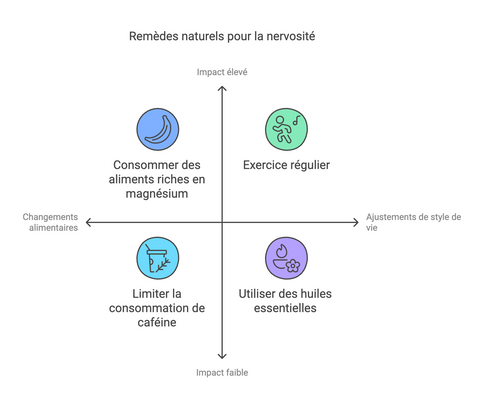
According to ANSES (the French Agency for Food, Environmental and Occupational Health & Safety), nearly 70% of French people have insufficient magnesium intake. A deficiency typically manifests as nervousness, irritability, muscle cramps, sleep disturbances, and persistent fatigue. Restoring optimal levels requires a diet rich in magnesium (dark chocolate, nuts, legumes, whole grains) and, if necessary, supplementation.
Among the available forms of magnesium supplementation, magnesium bisglycinate is the best absorbed and best tolerated by the digestive system. The less expensive oxide and sulfate forms have significantly lower bioavailability and are often responsible for digestive problems. The effective dose is between 200 and 400 mg of elemental magnesium per day. Our article onmagnesium bisglycinate details the selection criteria.
3. Regular physical activity
Physical exercise is one of the most scientifically validated natural remedies for reducing nervousness and chronic stress. It works through several complementary mechanisms: the release of endorphins and serotonin, the reduction of circulating cortisol, improved sleep quality, and a decrease in mental rumination.
Thirty minutes of moderate physical activity per day is enough to see significant benefits for nervous system balance. Yoga is particularly recommended for people suffering from nervousness because it combines gentle physical activity, breathing exercises, and mindfulness, thus addressing all three dimensions of anxiety. Outdoor walking, swimming, and tai chi also offer an excellent benefit-to-effort ratio for those who are not very athletic. Our article on the best anti-stress sports compares the different options according to individual profiles.

4. Relaxing essential oils
Certain essential oils have well-documented anxiolytic effects. True lavender essential oil (Lavandula angustifolia) is the most studied: several clinical trials confirm its calming properties on the nervous system, with an effect observable within minutes of inhalation. It can be used in an aromatherapy diffuser, by direct inhalation from the bottle, or diluted in a carrier oil for massage onto areas of tension.
Ylang-ylang essential oil has hypotensive properties and slows the heart rate in cases of acute stress. Roman chamomile is particularly indicated in cases of emotional shock or intense anxiety. Bergamot and petitgrain bigarade are known for their rebalancing effects on the autonomic nervous system.
These oils should be used with caution: always diluted for topical application, and not recommended for pregnant or breastfeeding women, or children under 6 years old. If in doubt, consult a pharmacist or aromatherapist.
5. Herbal infusions
Several plants have a long tradition of use for calming nervousness and are now supported by preliminary clinical data. Valerian is known to promote relaxation and support natural sleep. Passionflower is traditionally used for its calming properties on nervous conditions. Lemon balm acts on both the nervous and digestive systems, which are often disrupted by stress. Linden, chamomile, and poppy complete this range of soothing plants.
For optimal effectiveness, prepare the infusion with simmering (not boiling) water and let it steep, covered, for 10 minutes to preserve the active ingredients. Two to three cups a day, including one in the evening before bed, is a reasonable approach. Our article on the best anti-stress herbs details their properties.
6. CBD as a support for relaxation
CBD (cannabidiol) is a molecule extracted from hemp, legal in France, and used by over 6 million French people for everyday relaxation. It's important to note that CBD is classified as a "Novel Food" by European authorities and does not have any validated health claims. Its use is based primarily on observational data and user feedback, as well as preliminary studies suggesting an effect on serotonergic receptors involved in stress management.
CBD is now available in many forms. Sublingual oils offer the fastest absorption, with effects felt within 15 to 45 minutes. Gummies and capsules provide a convenient alternative with a more gradual onset of action. Creams and balms allow for topical application to relieve muscle tension. To learn more, our article on CBD for relaxation presents the available information and usage tips.
Dietary supplements to calm the nerves
The market for natural supplements for nervous system balance has grown considerably in recent years. Several product categories can be distinguished according to their composition and mode of action.
Supplements containing standardized saffron represent the best-documented category, with validated EFSA claims. They are available as gummies, capsules, or tablets, often combined with vitamin B6, which enhances their effect on the nervous system. The effective dose is 30 mg of standardized extract per day, preferably taken in the morning.
Magnesium bisglycinate supplements constitute a second essential category, particularly suitable for people experiencing physical symptoms of nervousness (cramps, tension, palpitations). The bisglycinate form is preferred due to its superior bioavailability and optimal digestive tolerance.
Multi-plant complexes combine several adaptogenic and calming plants (rhodiola, ashwagandha, passionflower, lemon balm) for a synergistic effect. These formulations are particularly suitable for people suffering from chronic, multidimensional stress. Finally, complexes including melatonin are specifically indicated when nervousness is accompanied by significant sleep disturbances.
Regardless of the supplement chosen, regular intake is more important than a single dose. A minimum of four weeks of daily intake is generally necessary to assess a supplement's effectiveness on nervous system balance. In cases of intense or persistent nervousness, a medical consultation is essential.

Frequently asked questions about natural remedies to calm nerves
What are the most effective natural remedies for nervousness?
The best-documented remedies are saffron (EFSA-approved claims regarding emotional and nervous system balance), magnesium (EFSA-approved claims regarding nervous system function), and regular physical activity. Lavender essential oil and calming herbal infusions are excellent complements to these fundamental approaches.
How long does it take to see the effects of natural supplements?
The time it takes to see results varies depending on the product and the individual. For saffron, the first improvements are generally observed after 2 to 4 weeks of regular use. For magnesium, a month of supplementation is necessary to replenish stores. Daily consistency is the key factor: natural supplements act deeply and gradually, unlike anxiolytic medications.
Can several natural remedies be combined?
Yes, a multimodal approach is generally more effective than a single solution. The combination of saffron and magnesium is particularly well-documented. Combining supplements, physical activity, and relaxation techniques yields the best long-term results. If you are currently taking medication, medical advice is necessary before starting any supplements.
Can nervousness require a medical consultation?
Yes. If nervousness is intense, persistent, and significantly impacts daily life (work, relationships, sleep), a medical consultation is essential. Some anxiety disorders require specific treatment, particularly CBT (cognitive behavioral therapy), the effectiveness of which is well-documented. Natural remedies can complement medical care but should not replace it.
Are stress and nervousness the same thing?
No. Stress is the body's response to an identifiable external factor (a threatening situation, a deadline, a conflict). Nervousness is an internal state of arousal that can exist independently of any apparent external factor. The two are related and feed off each other, but their mechanisms and management can differ.