
Stress activates the sympathetic nervous system and triggers a cascade of physiological reactions: increased heart rate, faster breathing, and cortisol secretion. These reactions are appropriate for an immediate threat, but become problematic when they persist. Breathing is one of the few bodily functions that we can voluntarily control, making it a direct tool for calming the nervous system and preparing the body for sleep.
Why breathing affects stress
By slowing and regulating your breathing, you activate the parasympathetic nervous system: this is the "rest and digestion" branch of the autonomic nervous system, the opposite of the stress response. This activation reduces cortisol production, slows the heart rate, and lowers blood pressure. The body receives the signal that there is no danger and can begin to prepare for rest. To understand precisely how stress interferes with sleep cycles, our article on the links between stress and sleep disorders details these mechanisms.
Three effective breathing techniques
Abdominal (diaphragmatic) breathing
Abdominal breathing is the most fundamental. Most adults breathe shallowly with their chest, which maintains a state of mild nervous system activation. Breathing with the diaphragm reverses this mechanism.
How to practice: Lie down or sit comfortably. Place one hand on your stomach and the other on your chest. Inhale slowly through your nose, expanding your stomach like a balloon: the hand on your stomach should rise, while the hand on your chest remains still. Exhale gently through your mouth, allowing your abdomen to deflate. Practice for 5 to 10 minutes before bedtime to gradually relax your body.
Dr. Weil's 4-7-8 technique
This method is particularly effective for quickly stopping a surge of anxiety or facilitating sleep. The longer exhalation time (8 seconds) compared to the inhalation intensely activates the parasympathetic nervous system.
How to practice: Sit comfortably and close your eyes. Inhale through your nose for 4 seconds. Hold your breath for 7 seconds. Exhale slowly through your mouth for 8 seconds. Repeat 4 cycles at first, then gradually increase to 8 cycles. This rhythm slows the heart rate and calms the nervous system within minutes, making it easier to fall asleep quickly .
Alternate nostril breathing (Nadi Shodhana)
Originating from yoga, alternate nostril breathing balances the activity of the two cerebral hemispheres and calms the mind. It is particularly useful for people whose stress manifests as racing thoughts.
How to practice: Sit with your back straight. Place your right thumb over your right nostril and inhale through your left nostril. Close your left nostril with your ring finger, open your right nostril, and exhale. Inhale through your right nostril, close it, open your left, and exhale. Continue this alternation for 5 to 10 minutes. This technique calms anxiety and prepares the nervous system for rest.
Heart coherence: a daily practice
Heart coherence involves breathing at a regular rate of 6 breaths per minute (5 seconds inhaling, 5 seconds exhaling) for 5 minutes. Practiced three times a day (morning, noon, and evening), it reduces cortisol levels in a lasting way. The effects accumulate with regularity: after a few weeks of daily practice, stress reactivity decreases measurably.
Incorporate breathing into your evening routine
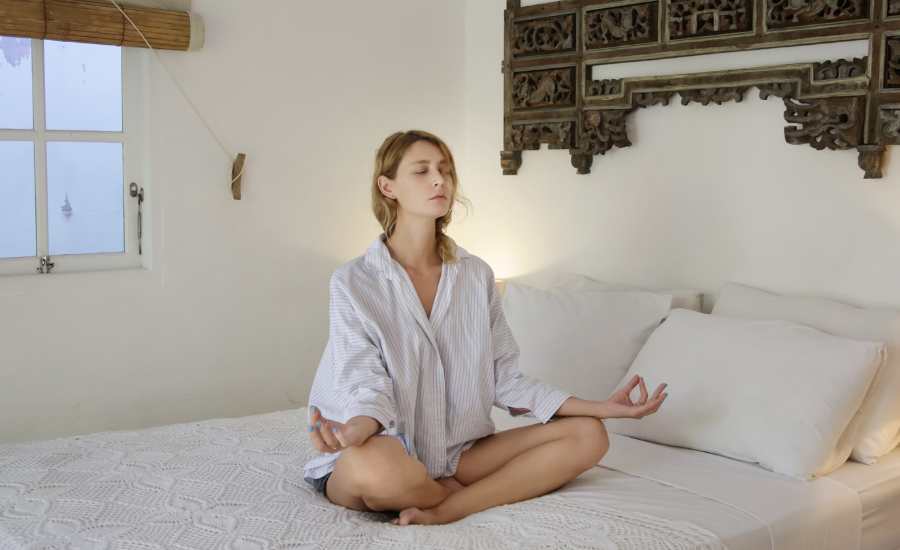
These techniques are most effective when integrated into a consistent evening routine. A few additional elements enhance their impact: turning off screens an hour before bedtime (blue light inhibits melatonin), creating a relaxing atmosphere with lavender or chamomile essential oils, combining breathing exercises with a short meditation, and taking a lukewarm shower to lower body temperature. For a complete routine, our article on how to relax for better sleep offers a structured program.
These breathing techniques require no equipment, can be used anywhere, and produce results in minutes. They form the basis of natural and lasting sleep hygiene.
Frequently asked questions about breathing and stress
How long does it take to feel the effects of breathing exercises?
The immediate effects (slower heart rate, a feeling of calm) are felt from the very first session, within 2 to 5 minutes. Lasting effects on overall stress levels develop after 2 to 3 weeks of regular practice. Daily practice of heart coherence produces measurable results on cortisol levels within 4 to 6 weeks.
Can these techniques be practiced during the day, not just in the evening?
Yes, and it's even recommended. Abdominal breathing and heart coherence can be practiced at any time of day, including at the office or while commuting. They are particularly useful before a stressful situation (meeting, public speaking) or during a break to reduce the buildup of tension throughout the day.
What is the most effective technique for falling asleep quickly?
The 4-7-8 technique is often cited as the most effective for falling asleep, thanks to its long exhalation time which intensely activates the parasympathetic nervous system. Abdominal breathing is easier to maintain over time. Ideally, start with 4 cycles of 4-7-8 and then continue with abdominal breathing until you fall asleep.