
Damaged hair doesn't appear overnight. It sends early warning signs that we learn to recognize so we can intervene before the damage becomes irreversible. Here's how to identify them, understand their causes, and restore healthy hair.
Signs that reveal damaged hair

The first indicator is the presence of split ends . When the keratin in a hair fiber is weakened, it cracks lengthwise and separates in two, forming a characteristic Y shape. A white spot (an air bubble) may also be observed on the hair shaft, a sign that the internal structure of the hair is compromised. To spot these, simply examine the ends against the light.
A rough texture is another reliable sign. Healthy hair is smooth because its scales (the cuticle) are flat and tightly closed. Damaged hair has raised or torn scales, creating a rough surface that can be felt by running your fingers along a strand from the ends to the roots. Visually, this type of hair resembles straw, looking dull and lacking volume.
The lack of shine stems directly from this condition of the cuticle. The flattened scales of healthy hair reflect light evenly, resulting in natural shine. Raised scales scatter light in all directions, giving a dull, matte appearance, regardless of the quality of the styling products used.
Other signs confirm advanced damage: reduced elasticity (healthy hair can stretch 30% before breaking, very damaged hair breaks as soon as it is pulled slightly), recurring knots that are difficult to untangle, and high porosity (highly porous hair absorbs water quickly but loses it just as quickly, leaving it dry despite care).
The main causes of damaged hair
Keratin, an insoluble protein that makes up approximately 95% of the hair fiber, can be damaged by numerous factors. The heat from styling tools is the most frequent cause: straighteners and curling irons used above 180°C break down the disulfide bonds of keratin with each pass. Using these tools without heat protectant spray significantly accelerates this damage.
Chemical coloring and bleaching alter the internal structure of the hair by opening the cuticles to deposit or remove melanin. The more the hair is bleached, the more its keratin is degraded and its porosity increases. Relaxers and perms have a similar effect.
Excessive or aggressive brushing worsens existing damage: split ends travel up the hair shaft if left untrimmed, and vigorous brushing of wet hair (when the fiber is most fragile) causes breakage. Environmental factors also contribute: prolonged sun exposure without protection, hard water that deposits minerals on the cuticle, and air pollution. Finally, nutritional deficiencies in protein, iron, zinc, or B vitamins directly impact the quality of the hair fiber produced by the hair follicle.
How to repair damaged hair?
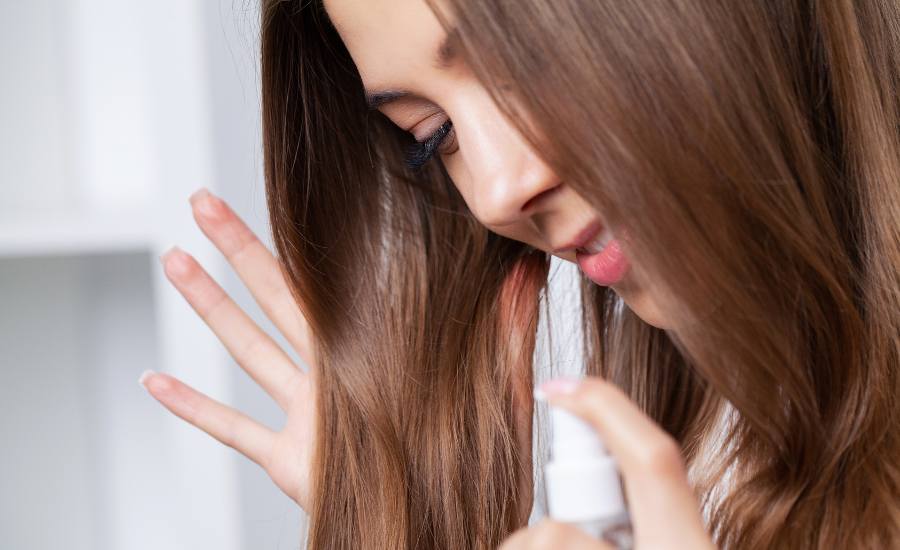
The priority is to trim the split ends . This is the only way to eliminate them: no treatment will permanently "glue" them in place. A trim every 2 to 3 months removes a few centimeters of length but preserves the healthy lengths and gives a fuller appearance, as the split ends are generally thinner.
Oil treatments are particularly effective for nourishing and strengthening the hair fiber. The most suitable plant oils for damaged hair are castor oil (rich in ricinoleic acid, it strengthens the hair shaft), coconut oil (penetrates the cortex and reduces protein loss), and avocado oil (rich in oleic acid and fat-soluble vitamins). Apply them to dry hair, focusing on the lengths and ends, and leave them on for at least an hour under a heated cap before shampooing.
Daily protection involves several simple adjustments: space out shampoos (every 2 to 3 days for most hair types), always use a heat protectant before any heat styling tool, limit heat to a maximum of 160-180°C, and let hair air dry as much as possible. For sleeping, a satin pillowcase reduces nighttime friction that helps lift the hair cuticles.
From a nutritional standpoint, sufficient intake of protein, biotin (vitamin B8), zinc, and iron is essential for the synthesis of high-quality keratin. Biotin, in particular, plays a key role in keratinization: studies show that supplementation improves the strength of nails and hair in cases of proven deficiency. Our article on essential vitamins for hair details the key nutrients and their dietary sources.
Frequently asked questions about damaged hair
Can damaged hair become healthy again?
The damaged portion of a hair cannot be permanently repaired: keratin damage is irreversible. Treatments can temporarily smooth the cuticles and improve appearance, but the only lasting solution is to gradually trim the damaged lengths while new, healthy hair grows from the root. With a suitable routine, a visible improvement in the quality of the new growth can be seen within 2 to 3 months.
What is the difference between dry hair and damaged hair?
Dry hair lacks surface lipids (insufficient sebum or sebum washed away by frequent shampooing), which makes it dull and dehydrated. Damaged hair has suffered structural damage to the keratin and cuticle. Hair can be dry without being structurally damaged, and vice versa. The appropriate care differs slightly: dry hair benefits primarily from oil-based treatments, while damaged hair needs protein-based treatments to strengthen its structure.
How many times a week should I use a hair mask for damaged hair?
A nourishing mask once or twice a week is generally sufficient for moderately damaged hair. For very porous and severely damaged hair, you can alternate a nourishing mask with a protein treatment (based on hydrolyzed keratin or amino acids) to both nourish and strengthen the hair structure. Using a mask more than twice a week risks overloading the hair, which weighs it down and gives it a dull appearance.