
A night's sleep is not a uniform state. It consists of successive cycles, each divided into distinct phases that fulfill specific biological functions. Understanding these phases helps us better grasp why sleep quality matters as much as its duration, and why some awakenings leave us feeling rested while others generate persistent fatigue.
How sleep works: cycles and biological clock
Sleep is governed by the biological clock, located in the hypothalamus, which regulates circadian rhythms over a 24-hour period. This internal clock determines when the body needs to sleep and be awake. It is primarily synchronized by light, but also by eating habits, stress, and physical activity.
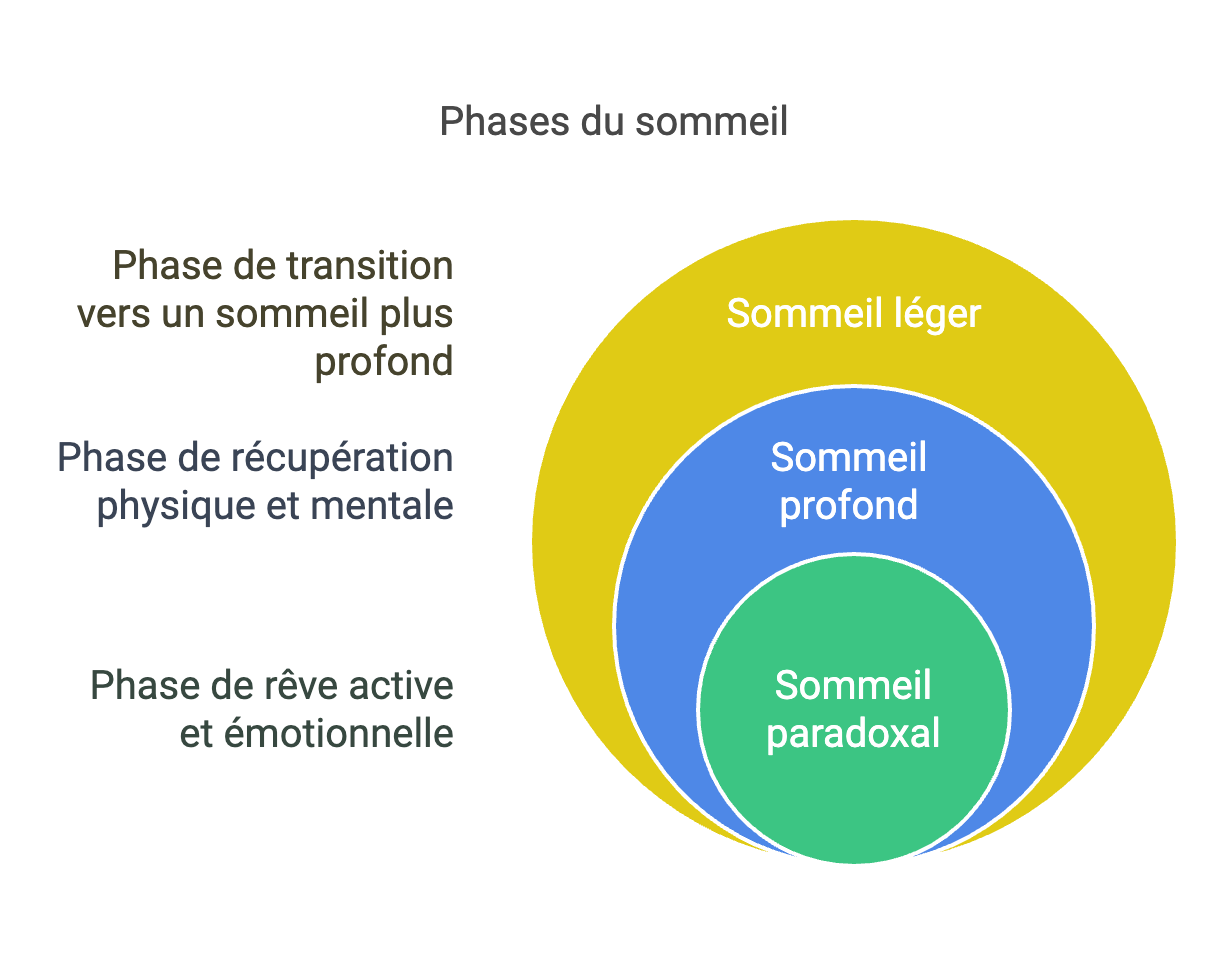
A full night's sleep consists of between 3 and 6 sleep cycles, each lasting approximately 90 minutes. These cycles repeat throughout the night and are subdivided into three main phases: light sleep, deep sleep, and REM sleep. The composition of these cycles changes throughout the night: the earlier cycles are richer in deep sleep, and the later ones in REM sleep. For a comprehensive overview of the mechanisms of sleep, our article on understanding sleep provides a foundation.

The three phases of sleep
Light sleep: the transition to rest
Light sleep marks the beginning of each cycle and represents 40 to 60% of total sleep time. The heart rate slows, breathing becomes regular, and muscles begin to relax, although sudden movements may still occur. A person in light sleep can easily wake up at the slightest noise or movement.
This transitional role is essential: it is during this phase that the body prepares the physiological conditions necessary to enter deeper sleep phases. The quality of light sleep therefore directly influences the quality of the deep sleep that follows.
Deep sleep: the heart of physical recovery
Deep sleep accounts for 20 to 25% of total sleep time and is concentrated mainly in the first part of the night. Brain activity slows considerably, showing delta waves on electroencephalograms. The body reaches its level of maximum relaxation.
This is the most restorative phase physically. Tissues repair themselves, the immune system strengthens, and growth hormone secretion reaches its peak. Upon waking after a deep sleep, the feeling of rest is at its maximum. Conversely, being forcibly awakened during deep sleep generates marked sleep inertia, a feeling of "fog" that can last for several minutes. It is also during this phase that episodes of sleepwalking and sleep talking occur.
REM sleep: the phase of dreaming and memory
REM sleep, which represents about 20% of total sleep time, occurs at the end of the sleep cycle. Its name comes from its apparent paradox: brain activity is intense, close to the state of wakefulness, while the muscles are almost completely paralyzed. The eyes make rapid movements under the eyelids, hence the English name REM (Rapid Eye Movement). Breathing and heart rate become irregular.
This phase plays a central role in memory consolidation, emotional processing, and creativity. It is during REM sleep that the most vivid and memorable dreams occur. Mood regulation depends largely on the quality of this phase: people deprived of REM sleep exhibit increased irritability and poorer stress management.
How many hours of sleep according to age?
The ideal amount of sleep varies depending on age and individual. General recommendations, based on research from the National Sleep Foundation, are as follows: 12 to 15 hours for infants, 9 to 11 hours for children, 8 to 10 hours for teenagers, and 7 to 9 hours for adults. These needs decrease slightly after age 65, but should never fall below 7 hours for optimal rest.
Regular bedtimes and wake-up times are just as important as sleep duration. Frequent variations in bedtimes disrupt the circadian rhythm and reduce the proportion of deep sleep, even if the total duration remains the same.
The risks of chronic sleep deprivation
Insufficient or poor-quality sleep has documented effects on health. In the short term: persistent fatigue, attention and memory problems, irritability, and difficulty managing stress. In the long term, studies link chronic sleep deprivation to an increased risk of cardiovascular disease, type 2 diabetes, obesity, and depression.
In children, lack of sleep slows growth, affects cognitive development, and disrupts emotional regulation. For adults suffering from persistent sleep disorders, our article on natural remedies for insomnia presents the best-documented approaches.
How to optimize the quality of your sleep cycles
Several practical habits can improve the quality of sleep cycles. Going to bed and waking up at fixed times stabilizes the circadian rhythm. Avoiding screens in the hour before bedtime limits the inhibition of melatonin by blue light. Keeping the bedroom cool (16-18°C), dark, and quiet creates the physiological conditions favorable to falling asleep quickly and enjoying deep, quality sleep.
For mild to moderate difficulty falling asleep, certain plants are well-documented: valerian, passionflower, poppy, and linden. Essential oils for sleep (lavender, sweet orange, and Roman chamomile) can also promote relaxation before bedtime. Calm evening activities, such as reading, puzzles, or listening to soothing music, prepare the nervous system for rest.
Frequently asked questions about sleep stages
Why do we sometimes wake up in the middle of the night for no apparent reason?
Waking up between sleep cycles, approximately every 90 minutes, is physiologically normal. Generally, we fall back asleep so quickly that we don't remember it. A prolonged, conscious awakening often signals a disturbance: stress, excessively high temperature, sleep apnea, or a rebound effect after consuming alcohol in the evening.
Is REM sleep essential?
Yes. Studies on selective REM sleep deprivation show rapid effects on memory, emotional regulation, and creativity. People chronically deprived of this phase have an increased risk of anxiety and depressive disorders, regardless of their total sleep duration.
Why do children need more sleep than adults?
During childhood and adolescence, deep sleep is more abundant and growth hormone secretion is at its peak. The developing brain also needs more REM sleep to consolidate learning and structure neural connections. These needs gradually decrease as brain development stabilizes.