
You've probably read on your CBD oil packaging: "place the drops under your tongue." But why this method rather than swallowing directly, mixing it into a drink, or applying it to your skin? The answer is pharmacological—and understanding this mechanism will help you get the most out of your CBD oil.
Sublingual absorption: how does it work?
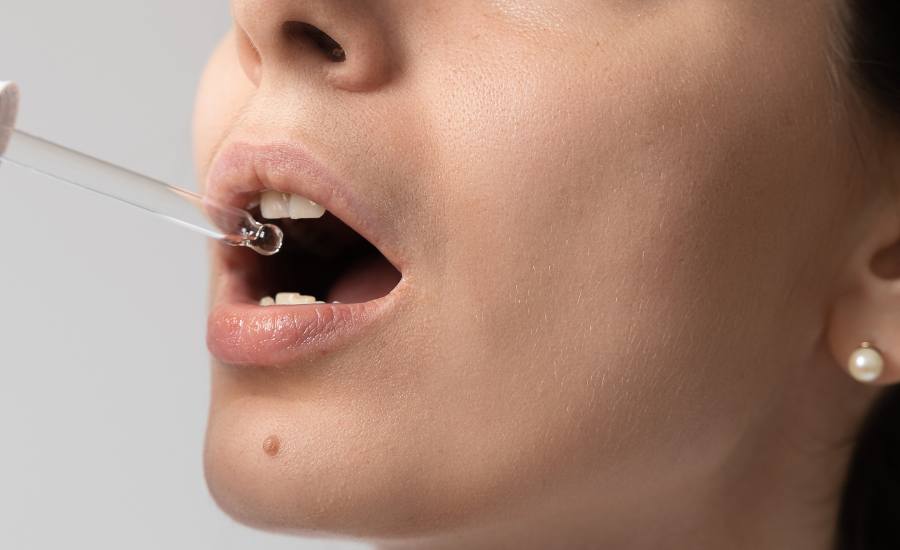
The sublingual mucosa — the thin tissue located under the tongue — is one of the most richly vascularized areas of the body. It is supplied by a dense network of blood capillaries directly connected to the general circulation.
When you place drops of CBD oil under your tongue and hold them there for 60 seconds, the cannabidiol passes through this thin mucous membrane and goes directly into the bloodstream, bypassing the digestive system. This mechanism is called sublingual transmucosal absorption.
The result: the effects are felt in 15 to 45 minutes , compared to 1 to 2 hours for classic ingestion (swallowed directly or mixed with food).
Why avoid passing through the digestive system?
When a substance is swallowed, it passes through the stomach, the small intestine, and then the liver before reaching the bloodstream. This process is called the "first-pass hepatic metabolism." The liver metabolizes (breaks down) a large portion of the active substances before they can have any effect.
For ingested CBD, oral bioavailability—that is, the fraction actually usable by the body—is estimated to be between 6 and 19%, according to studies. In other words, if you swallow 20 mg of CBD directly, your body will only actually use 1.2 to 3.8 mg.
Sublingual administration bypasses the first pass through the liver, increasing bioavailability to 20-35% , depending on the formulation, and sometimes even higher. This is why the same dose produces a more pronounced and faster effect than with simple ingestion. To learn more about the optimal dosage for your individual needs, our article "How Many Drops of CBD Oil to Take" will guide you step by step.
Comparison of CBD administration methods
To fully understand the advantage of the sublingual route, here's how it compares to other methods:
Sublingual (under the tongue) : onset of action 15-45 minutes, bioavailability 20-35%, duration of effect 4-6 hours. Ideal for relatively rapid action and precise dosing.
Ingestion (swallowed, mixed with food or drink) : onset of action 1-2 hours, bioavailability 6-19%, duration of effect 6-8 hours. More convenient for masking bitterness, but less effective and less predictable. Better suited for planned, long-term use.
Inhalation (flowers, e-liquids) : onset of action 2-10 minutes, bioavailability 30-56%, duration of effect 2-3 hours. Very rapid action, but this route is not recommended due to the respiratory risks associated with inhalation.
Topical application (cream, balm, massage oil) : acts locally only on cutaneous and muscular CB2 receptors, without entering the bloodstream. Ideal for localized pain, with no systemic effects. Complementary to oral intake for joint or muscle pain. To learn more about this type of use, our article on CBD and joint pain details local applications.
How to optimize sublingual absorption?
To maximize absorption, a few simple steps make all the difference:
- Place the drops directly onto the sublingual mucosa (under the tongue, not on the tongue or on the cheeks).
- Keep the drops in place for a minimum of 60 seconds before swallowing — ideally 90 seconds for highly concentrated oils.
- Avoid eating or drinking for 15 minutes after taking the medication to prevent disrupting absorption.
- The quality of the carrier vegetable oil influences bioavailability: oils based on avocado or sweet almond oil generally offer better CBD solubility than refined coconut oil (MCT).
If the bitterness of CBD is a concern, you can rinse your mouth with a sip of water after holding it for a minute, or opt for a flavored formula (mint, citrus). To choose a quality oil suited to your needs, our article "Which CBD Oil to Choose" details the essential criteria. And to find out the best time of day to take your oil, consult our guide "When to Take CBD ."
Regarding the regulatory framework, ANSES publishes reference information on cannabidiol and its Novel Food status in France .
Frequently asked questions about sublingual CBD intake
What happens if I swallow the drops directly without holding them under my tongue?
CBD is absorbed through the digestive system via a first-pass metabolism in the liver. The effects will be slower (1-2 hours) and less intense for the same dose, as a significant portion of the CBD will be metabolized by the liver before reaching the bloodstream. This is not dangerous, but it is less effective.
Can you mix CBD oil into your morning coffee?
Yes, it's possible and convenient for masking bitterness. However, be aware that heat can partially degrade cannabinoids, and that digestion will reduce bioavailability. For optimal effect, use it sublingually before drinking your coffee.
Does the sublingual route work better on an empty stomach?
The sublingual mucosa functions independently of stomach fullness. Taking CBD on an empty stomach or after a meal does not significantly influence sublingual absorption, unlike conventional ingestion where a fatty meal improves the bioavailability of ingested CBD.
Updated June 2026: As of May 15, 2026, CBD products intended for ingestion (oils, gummies, candies, infusions, food supplements) are no longer authorized for sale in France under the European Novel Food Regulation. An appeal is currently pending before the Council of State; this article will be updated depending on the outcome.
Sources
- Millar SA et al. (2019). A Systematic Review on the Pharmacokinetics of Cannabidiol in Humans. Frontiers in Pharmacology, 10:1365.
- Huestis MA (2007). Human Cannabinoid Pharmacokinetics. Chemistry & Biodiversity, 4(8):1770-1804.
- ANSES. CBD (cannabidiol). anses.fr